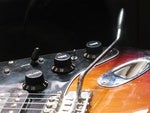
|
|
Post by JohnH on Jan 10, 2009 16:15:09 GMT -5
My holiday project has been building a cab, which I wanted to be able to use with electric and acoustic inputs. I needed a full frequency range available for the acoustic/piezo input, but controllable so that this can be curtailed to still sound good with overdriven electric guitars. It strikes me that this wish may be becoming more common. There are an increasing number of hybrid guitars that create acoustic and electric sounds, either by modelling or just by mixing of piezo pickups, (Line 6 Variax, Fender VG Strat, Gibson Darkfire, Epiphone ultra, and others), plus most acoustic guitars these days come with a piezo pickup. None of these bring out their true zingy strummy acoustic nature through a guitar amp with a frequency range that falls away at 4 or 5kHz, whereas distorted electric guitars sound fairly painful if you have to hear the full range of distortion products up to 20khz . What I found out, is that it is easy enough to get piezo horn tweeters working in parallel with a guitar speaker. I built two of them into this cab, and they are switchable to have them off, or with two levels of ‘on’ to allow adjustment of presence. These tweeters are very cheap, they take very little current and do not need a cross over. Hence the main speaker and the amp are happy with or without the piezos switched in. The idea could therefore also be made into a separate small tweeter box to plug in parallel with a normal cab, however, I have it built right into the cab. My cab is 570mm x 460mm x 360mm at the base and 330mm at the top, and has a 100W 12” Celestion main driver taken from my Marshall DSL combo, where it was replaced by a Vintage 30. The cab dimensions match the front face and front slope of the Marshall, so it can sit under it as a stack. The width matches that of my Marshall cab, and the feet sit into cups on top of the old cab, so that gives another stack option for use with a separate amp. The cab is built from 15mm ply, butt jointed with 19 x 42 battens screwed, with glue on all joints except the back. I rounded off the corners by hand, and it is finished in black chalkboard paint and black metal corners. I haven’t tried to match the Marshall style, since I would fail, except for the brass screws in the corners, which are a small reference to the rivets that Marshall use. The grill cloth is stapled to a wooden frame and fixed by screws from the back. Stretching the cloth would have been the fiddliest job of all, except I had assistance from some crafty female fingers – (and I now need to build her a deck!). The size of the cab is reasonably generous for a 1 x 12, and the first intention was to make it a closed back cab. But when I first tested it unfinished, I found that it had a lot more life with the back partly open, and so it now has a large oval slot in the back. This gives it a more space-filling, lively sound. Other theories embodied were, the back and front are not parallel to reduce resonances, and the speaker is positioned slightly above the centre to get it further from the ground and also reduce symmetry which leads to resonance. The back has a central stiffening batten, and some carpet attached internally to damp its vibrations. Also, there is a beam blocker across the front to diffuse treble from the main speaker. The piezos are angled slightly upwards and outwards in addition to the front baffle slope, to help spread the sound. When I came to test the piezos, I tried various wirings in parallel and series. These bullet horn piezos are usually wired in parallel, with a small resistor in series, but I found this was too dominant. I settled on putting the piezos in series, together with a switchable series resistance of 270 Ohms or 270 + 820 Ohms. This is quite a lot of attenuation, and it also allows the natural capacitance of the piezos to trim down the high treble. I picked these values based on listening tests with three amps (the DSL tube amp, a small Marshall solid state amp and a Crate Powerblock Class D amp) and several guitars, plus feeding in some AC/DC (the band, not the voltages!) to see how it sounds as a full range system. I figure that with the 270 Ohm series resistor, I’m getting a roll off from about 10khz upwards. The combined resistances of 1090 Ohms roll off through all the frequencies that the piezo contributes, but they are still there to be heard as a small enhancement to the sound. At the minimum setting, the piezos just add a bit of presence and sparkle to the high end without sounding harsh, and the higher setting it works with fully acoustic or music input. With high gain, its best switched off. It is sounding great with the little Crate head on it and is also a good bottom cab for the Marshall. Here's some pictures:  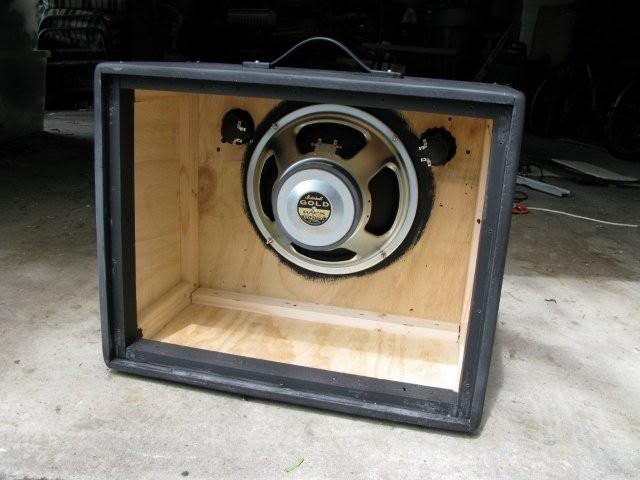      Cheers John |
|
|
|
Post by lpf3 on Jan 10, 2009 18:16:10 GMT -5
John -
Really nice job !
On rereading you post I see where you came up with this size .
My question is , how much does the cabinet size affect the tone or the speaker's performance ? I have some PA speakers & I'd like to cut the cabinets down .
Any thoughts ?
Thanks
-lpf3
|
|
|
|
Post by JohnH on Jan 10, 2009 18:31:40 GMT -5
lpf3 - thanks for the comment. In a closed back cab, as the volume is reduced, the bass is reduced too. many PA cabs are ported, which creates a bass resonance, usually just below the frequencies that you want, so to boost the low end without needing a bigger cab. These things are carefully tuned. Theres a few programs that you can download to investigate this. I found WinISD to be the best. You can download it here: www.linearteam.dk/John |
|
|
|
Post by cynical1 on Jan 10, 2009 18:44:08 GMT -5
John -
Yes, that is a nice looking cabinet. Very clean and simple...quite the classy job. It's been a while since I've seen anyone putting piezo's in a cabinet. That was all we used back in the day, then they seemed to fall out of favor. Shame, they're so efficient for the price, and like you said, no crossover.
If you could toss up some sound samples that would be interesting.
lpf3 -
Changing the dimension of the cabinet can have an effect on what comes out of a cabinet...tone and efficiency. Somewhere buried with all my books I have the formulas for calculating cabinet size to speaker/driver...but I'm sure the Internet has the same info much more readily accessed...
Not knowing what you've got makes it tough to give you a good appraisal...that, and I haven't really played with this stuff in a long time...CRS...
Happy Trails
Cynical One
|
|
|
|
Post by andy on Jan 10, 2009 19:54:52 GMT -5
You could be right- I've always wondered why hybrid guitars don't come with two outputs, one to go to a standard electric amp, one to go to a P.A. or separate 'acoustic amp'. It looks like you've come up with a good solution to the issue though, and done a tidy job of it too!
|
|
|
|
Post by JohnH on Jan 10, 2009 20:15:02 GMT -5
cynical1 - I'll be happy to try some sound clips, if I can get some that sound meaningful in relation to how the cab sounds naturally. Usually when I do sound clips to show off guitar or amp sounds, I do a mixture of close miking one speaker, a bit off axis, plus a second channel of cab-simulated DI out. Plus I only have one decent mike (a Shure PG57), and one mike input on my mixer!
None of that would make much sense here, so I guess I'll just place the mike somewhere in front, far enough back to catch some of each speaker type! - any better tips?
Andy - I think at least the recent Gibson Darkfire and maybe Epiphone hybrids may have those two outputs. When I was putting a piezo pickup into the red guitar shown above, there was a moment when I had it temporarily wired with seperate acoustic and electric signals to two amps. That was really sounding interesting, like two distinct guitars and I might go back to that if I revise that guitar design further. I probably will, I get itchy if I dont rewire something for more than a few weeks!
John
|
|
|
|
Post by ChrisK on Jan 10, 2009 23:46:09 GMT -5
Excellent project John. Yes, but care must be taken to limit the low frequency amp response as well. If the speaker is driven below the resonant port frequency, the speaker is no longer acoustically loaded and can easily be overdriven. This is the primary reason why ported guitar cabinets must not be used with a bass guitar. Now, in primarily open back cabinets (really big ports) there's not much acoustic loading anyway, but speaker death still occurs. And this, boys and girls, is why many bass cabs are closed back (acoustic suspension). There is no peaking (the peaking of the bass reflex cab and rock are ideal for each other), but the frequency response falls off gradually and the acoustic loading is relatively consistent. Many do. My Godin xtSA, Nashville Power Tele (which also has a hex pickup added), and Parker all do. For the drivers (speakers, BTW, they're both from Oz, John)); en.wikipedia.org/wiki/Thiele/SmallFor the enclosure; en.wikibooks.org/wiki/Engineering_Acoustics/Bass_Reflex_Enclosure_DesignBack in my Glass Audio/Speaker Builder days (when I still thought that I could hear - the loud music that I listened to was mostly classical and Led Zeppelin), I used to design custom enclosures. You know, that pedestrian Isobarik/D' Appolito stuff. Man, talk about a money pit.....I'm glad I can't hear anymore. IsobarikName from the original loudspeakers that first used the design. The bass driver sits at the front of a tunnel of identical shape, a second bass driver is at the rear of this. As both drivers move in unison, the front driver gets the impression the speaker cabinet is about six times larger than it actually is, resulting in that equivalent amount of bass performance. D' AppolitoA design that has mirrored drivers around a central tweeter. These drivers can be woofers only or woofers (outside drivers) and mid-ranges (drivers closest to tweeter). www.speakerbuilding.com/content/1105/02_drawing.jpgSome links; en.wikipedia.org/wiki/Loudspeakeren.wikipedia.org/wiki/Guitar_speakeren.wikipedia.org/wiki/Loudspeaker_enclosurewww.hometheaterhifi.com/features/technical-topics/how-a-hole-in-the-box-works.htmlwww.humblehomemadehifi.com/www.speakerbuilding.com/ |
|
|
|
Post by JohnH on Jan 11, 2009 4:56:28 GMT -5
Thats good info Chris, thanks. I made some sound clips. It wasnt so hard, the mike is about 200mm off the front face, and I used 'phones to pick a place with a balance between piezo and main speaker. Having said that, these clips slightly overstate the piezo component. www.soundclick.com/bands/default.cfm?bandID=674084&content=songinfo&songID=7227841The amp is the Marshall DSL combo, just fed through the new cab, and set on its clean channel and at living-room volume. The guitar is the converted red Ibanez in the pictures, with its piezo and magnetic pickups. First in the sample is three versions of an acoustic style intro to 'Knockin on Heavans Door'. The guitar is using the piezo pickup (just a bit of magnetic too). The cab begins with my max piezo setting, then the piezos fully off (a bit dull), then the piezos re- engaged at low setting. That third one is the better of the three IMO. Hear the clicks as I switch the cab settings. Then, also using that minimum piezo cab setting, theres some rythym strumming on a neck magnetic pickup. Finally, some 'Houses of the Holy', bridge pickup, no piezo in the cab and crunch curtesy of a couple of my stomp boxes. To finish, same again but with full piezo (yikes - buzzy!) cheers John |
|
|
|
Post by andy on Jan 11, 2009 5:16:49 GMT -5
Ok, I take it back. It's not like me not to have done my homework on guitar specs, but I must have stuck to an assumtion there. If the Nashville Power Tele has two outputs, that is coming close to an all-time ideal 'out and about' guitar for me. Can't believe I missed that one.  |
|
|
|
Post by cynical1 on Jan 11, 2009 12:15:19 GMT -5
John - Thanks for firing up those clips. I've never really heard a good A-B comparison for piezo pickups before. Now I see what the fuss is all about. That is a very nice sounding cabinet. Amazing when you actually build the enclosure specifically for your drivers how well it works and sounds. And you point out the one reason, with the "Houses of the Holy" clip with piezo's, that probably killed piezo's in musical instrument cabinets...they are so clean they point out all your set-up problems and mistakes quite clearly...not that you're a sloppy player by any means. Now you have me inspired. Back in the day I was a partner in a musical instrument cabinet business that built enclosures based on the Karlson design.  One of the partners had made the trip to aquire and pay for written license to manufacture from Ann Karlson (John's widow), along with 4 boxes of original drawings. We were off and running...until about 3 years later when we found that JBL had bought the exclusive rights from John years ago on the QT and sat on them... Long story short...a Cease and Desist order tends to put the screws to your operation in a New York minute... I still have two 15" bass enclosures that just blow the doors off anything else... But, ancient history aside, we tried to build a 2 x10 version that offered piezo's, with a pot and very similar switching to yours, for guitar. Since we used 500 particle per sq. in. particle board, 1" for the cab and 1-1/2" for the back, the damn thing weighed a ton. It sounded incredible, but you needed a team of horses and a small ox to lift it... Now I'm thinking about building one, again...that should thrill the wife to no end... Thanks for posting the details and clips John. You took me back to a time when my hair was neither gray nor stray... Happy Trails Cynical One |
|
|
|
Post by ashcatlt on Jan 11, 2009 13:46:20 GMT -5
Finally, some 'Houses of the Holy', bridge pickup, no piezo in the cab and crunch curtesy of a couple of my stomp boxes. To finish, same again but with full piezo (yikes - buzzy!) This (with the piezo) doesn't sound as bad as I'd expected, actually. Neither does that. It might be interested to hear this in comparison to a DI version of the same. I'm hearing some weirdness in the piezos, almost like they're a little disconnected from the rest of the sound. Like there's a noticeable gap in the frequency range between where the 12" falls off and the piezo takes over? The recording itself makes it difficult to judge. I'm sure part of what I'm hearing has to do with the mic placement and probably the interaction with the room. It's also a little tough to tell exactly what we're getting from the piezos cause I can hear the acoustic sound of the strings through the mic. I know this wasn't really meant to be a "studio quality" recording, but I think a bit more isolation would help us to identify exactly what this cab is doing for you. Ooh! Any chance you could play some full range music through the thing and record that? |
|
|
|
Post by JohnH on Jan 11, 2009 15:18:40 GMT -5
Thanks for listening. Your perceptions are very interesting, so to explore them, Ive made a composite screen shot of frequency spectra for the 6 clips, using the Audacity recording file:  The first three show how the piezo speaker fills in the top end, with the third clip showing the reduced piezo contribution a few db down from the first clip. All of those three have some kind of burst around 8khz, much reduced in the second clip (no piezo speaker). I think this effect must come from my piezo pickup, since it is not so evident in the later mag pickup recordings. Ash, if you are hearing the direct string sound, it would be most evident in clip 2, where thers no piezo. It could be there but I can't really hear it myself. I certainly was not taking too much care over recording technique. Also, the sound levels were not very high. A comparison with some redorded music would be interesting and not hard to do. Cynical1 - that speaker plan looks like an awesome design. I would think that considerable 'quality shed time' went into that! thanks again John |
|
|
|
Post by cynical1 on Jan 11, 2009 16:13:24 GMT -5
Cynical1 - that speaker plan looks like an awesome design. I would think that considerable 'quality shed time' went into that! Actually, the drawing I posted was the original design from the 50's. We found a nasty trait where this design would create a resonance around 100 hz (low G on a bass). We even created a standing wave in an empty club once with this...that was pretty cool...and it wasn't all just the drugs either... The "shed time" came in trying to eliminate it. We dropped the front middle baffle, changed the orientation of the port and added an additional angle to the top section of the of the internal baffling. That actually cleaned up the sound and solved the nasty little resonance problem...a lot of coffee and late nights went into that... These cabinets were like nothing else out there. The flare in the front was taken from a jet nozzle design Karlson patented back in the 50's. At 40% efficiency you could drive two 15" cabinets from a 100 watt head and drown out a Voice of the Theater cabinet pumping 300 watts...and it had an almost hi-fi sound...man, don't get me started... We had just started to see money coming back in. Emmit Chapman came out to visit us and traded us a stick for two cabinets. S.D. Curlee (which was two doors down from us) had a cabinet for testing and we had just signed a young Conquest Sound as a distributor. Legally, we had made enough changes to the original design to fight JBL, but they had deeper pockets then we did, and when they went after Conquest Sound (our only distributor) we were really screwed. The drawings we got from Ann Karlson all had the exponential flare horn laid out empirically...so more then a little work went into scaling it for different drivers. For the high frequency drivers a company named Transylvania Power Tube made a coupler based on the jet nozzle for HF drivers that was pretty good for PA and not quite as harsh on the 10" and 12" guitar cabinets as the piezos. But since the cabinets were heavy enough as it was not too many people opted for them.  I don't know if they're still in business, but I found a set on eBay for $224.00...as I recall we paid around $30.00 each for them back in 1977...wish I'd have snagged a few of those bad boys now... Well, enough memory lane... Happy Trails Cynical One |
|
|
|
Post by lpf3 on Jan 11, 2009 18:14:59 GMT -5
John - Nice sound clips - I think the acoustic sounds you're getting , either with the guitar , amp ( cabinet ), or both , are more believable than what I'm getting with COSM amp modeling or acoustic sims . Looks like your on the right track . Everyone - Thanks for the wealth of information on speaker cab construction , it's safe to say that my PA speakers will stay at their current size .  lpf3 |
|
|
|
Post by JohnH on Jan 14, 2009 16:45:44 GMT -5
I've been doing some more testing on this cab, in order to understand what I had made. I wanted to investigate the effect of opening part of the back, and also just what the piezos were doing. I had a feeling that closing the back may be giving a better more controlled bass. So Ive been doing some tests with white noise, and garage-level science. I got a white noise .wav file from the net, put it on an mp3 player and fed it to the amp. using a fully clean power amp stage. I miked the cab 1m from the front, and fed it to a mixer and into audacity. Then, plotted spectra and exported to Excel. With this set up, the measurement obviously is affected by everything in the chain, including the room, my mic set up, mixer etc. And the absolute numbers are not meaningful, but they are interesting to compare like with like.  At low frequencies, the piezo is not effective and the green and the blue lines approximately overlay each other, representing a closed back. I'm pleased with that, I'm getting a good coverage of he lower guitar frequencies, with a roll off at the low end which is quite normal. The red line represents my partly open back, and you can see much more peaks and dips down there which confirms what I heard in terms of unevenness. I think I'll be closing the back again. Through the upper mids, theres a bunch of ups and downs and the drivers interact with each other and the box and the room etc. Interesting, I'm not sure whether its good or bad, but it sounds fine! At the high end, the addition of the piezo (max setting, which I guessed above was rolling off at about 10kHz), shows response that falls away after 11 to 13 kHz - all good, I don't want anything higher in a guitar cab. The white noise trace is also there, just to show that it is reasonably linear. I might try the same test with a HiFi speaker, just for grins. John |
|
|
|
Post by newey on Jan 14, 2009 20:58:13 GMT -5
John- This is a tour de force of both craftsmanship and technical analysis. And it looks pretty cool, too, especially with the Powerblock atop. This allows one to write the band's name in chalk on the side of the cab, instead of the stencil-and-spraypaint technique. And it can be easily erased if the band changes.  One could take some pieces of chalk to the next show, and hand them out to pretty girls in the front row, inviting them to leave their phone nos.  OK, so I got a little carried away there . . . But a great build, and it does sound sweet. I am wondering if your piezo tweeter idea could be used with a bass speaker (err. . . driver) to make a cab usable for bass as well as acoustic guitar. The piezos would certainly be less weight than a cab with a horn and a crossover installed. Of course, one could always turn the piezo off completely and just run the bass driver, but I'm wondering if a piezo, attenuated as you have, might not add a little bit in the hghs. Is there a reason (besides "shade tree engineering") that you chose to use two piezos instead of a single one? |
|
|
|
Post by JohnH on Jan 14, 2009 23:22:24 GMT -5
Thanks newey - I used 2 piezos 'cos they were so cheap! ($8AU) - and they are rather directional, so with two, I can aim them up and apart to get more spread. It also allowed me try out series and parallel.
I think such devices could be added to any rig including bass, but one thing I didn't want was to (intentionally) compromise the function as a basic guitar speaker cab. So I probably wouldn't want to use a bass speaker plus piezo, as a way to cover guitar tonal ranges.
I think the most interesting thing that I learned with regard to the piezos is that they could be piggy-backed onto just about any electric guitar rig in order to get reasonable functionality with acoustic guitar. I see two piezos and some switching in a small box as being a useful and inexpensive separate unit.
John
|
|
|
|
Post by andy on Jan 15, 2009 11:04:23 GMT -5
John, I just got round to listening to the soundclips, and there are some really good acoustic like sounds in there. As you said the third piezo blend is particularly good. Having heard some pretty plastic-y sounding piezo's in both solid bodies and acoustics, I'm impressed. |
|
|
|
Post by JohnH on Jun 4, 2011 6:52:56 GMT -5
This post is about putting ports onto a 1x12 guitar cab. It’s not a common thing to do, most guitar cab designs are either simple closed back or open back. There are a few ported 1x12's on the market however, including one from Mesa, and combos from Orange and Marshall. Its much more common in PA cabs and bass cabs. The cab is my self built one - see the start of this thread. It's main purpose is to run as an extension cab beneath my open–backed Marshall combo, and also to be used on its own either for acoustic or electric guitar. With the combo its job is to add bass, hence the interest in porting. It’s other purpose is to be experimented on, it is contains every idea that I have had about things to add to guitar cabs. The cab is a reasonably generous size for a 1x12 , being 58 litres internal volume, and it has a Celestion Vintage 30 and some switcheable piezos. It was fine as was, but I had a sense that there was more bass to be had that was not being expressed. I used the program WinISD to investigate what might be possible. The idea was to use ports to tune to a resonance at a frequency a bit below that used for guitars, so that the resulting hump in the bass response extends up into the guitar range, but without being boomy. I set a tuning frequency for the ports at 63hz, which combined with the speaker, resulted in an overall resonance at about 50hz. To do this I had to make some assumptions about the speaker. I couldn’t find all the required Thiele-Small parameters for my speaker, so I assumed it was fairly similar to a G12-M Greenback, which is included in the program. This plot showed what might be achieved (green), as compared to fully closed (yellow):  This suggested about a 2db addition to low bass, using three 50mm ports 40mm long, which is what I did:  2db is not much, but it’s quite noticeable, and the cab does sound bigger with a more expansive bass now. Then I set up a mic recording to Audacity and fed in some white noise from an amp into the cab, recording with the new ports and also blocking them closed. The measurements, while not scientifically made, do show the comparative difference between closed and ported sounds:  Red and blue lines show the two results, and green is the diffence in db. It does indeed seem to confirm about a 2db boost below about 130 Hz – all good! There's a few wiggles in the response, wich I take to be due to the effects of the room. Its a subtle change for the better which is what I was after. Intererstingly, at very low frequencies below guitar range, the ported output is less than the fully closed, which is as expected. cheers John |
|
|
|
Post by sumgai on Jun 4, 2011 16:42:13 GMT -5
John, A long time ago, a gentleman posted, in the Usenets, the "old fashioned way" to determine the T/S parameters, including how to determine the exact impedance for one's driver (both value and at what frequency). Fortunately, that's been preserved over in the tomshardware forums. The second post should make your eyes go all glassy....: www.tomshardware.com/forum/40736-6-newbie-speaker-parameters-mesurment. HTH! sumgai |
|
|
|
Post by JohnH on Jun 4, 2011 18:19:07 GMT -5
Thanks sumgai - lots to learn there.
Looking around the net, I found a range of TS values for the same types of speakers. I tried a few different sets of values for various guitar speakers, and with what I was doing, it didnt change the overall conclusion that I could do this to get a bit more low end without messing up much else. I think the key is to be sure that the resonant frequencies are below guitar tones, then if they vary somewhat it doesnt cause a big issue.
One issue that did cause me to scratch my head however was the choice of port diameter v length. Given a choice of frequency and other parameters being equal, one can select more port area and longer port length, or smaller ports and less length. Too small ports can cause wind noises ('chuffing'), but avoiding that, I was still finding that I could pick a port size for which the correct length is just the box thickness, or go wider (or more ports) and hence use longer ports. The design equations did not show a difference in the response result, but I wasn't sure if there is a minimum port length/diameter ratio at which the equations break down.
John
|
|
|
|
Post by JohnH on Oct 11, 2017 14:13:38 GMT -5
I just restored the ex-Photobucket images on this old thread, so this is to give it a bump....
|
|
meatsalad
Rookie Solder Flinger

Posts: 1 
Likes: 0
|
Post by meatsalad on Oct 12, 2017 9:37:12 GMT -5
Thanks for restoring the images.
I would really like to mimmic your build but am pretty useless at electrics (but can paint by numbers). Can you give any details as to how to wire it? And also the latter porting you mentioned?
I spoke to Lean Business (UK) but they dont seem too interested as they dont supply piezos.
|
|
|
|
Post by JohnH on Oct 13, 2017 15:40:25 GMT -5
The piezo horns were wired like this in my cab:  The main speaker gets directly connected to the jack as in any normal simple wire up, and the piezo switching is applied in parallel to it. Some experimentation is advised to find the best tones. To get a bit more piezo, I might make th e270 ohm a 100 and put the h270 where the 820 is. Later on, I was working with 4real (sadly he has passed) on a much more versatile system to add to his Fender amp, and came up with this, which he built and liked:  On the cab build, this is the type of joints I used, with 15mm ply butted with a 19x48 batten, since its very strong and I'm not set up to do anything cleverer:  |
|
|
|
Post by JohnH on Oct 13, 2017 15:48:02 GMT -5
I cant yet find the sketch of my cab, but this is a similar one that I worked out for a guy on the Marshall forum, to go under his DSL40C. He built it really well, and I can probably find the thread about it there. It doesn't have piezos but it could have them. It also has a 3 piece back to experiment with open and semi-open, or ported:  See this about it: www.marshallforum.com/threads/dimension-specific-2x12-cab-for-dsl40c.71730/The ports (in one of the back pieces, not shown above) need to get worked out very carefully dependent on the internal volume of the cab and speaker properties. Most player will prefer a non-ported cab in a generously sized 1x12, but I like them. I could help work out ports if you wish, and I like the sound of the results I get (see also tests in this thread above). But I've also been told that the way I do it is completely 'wrong'. I originally added the ports because although my 1x12 was sounding quite nice, it didn't have the rich bass of a 4x12 that I had, but wanted to sell to save space. Adding the ports got it a lot closer so I was happy to lose the bigger cab. |
|
|
|
Post by JohnH on Oct 13, 2017 16:43:42 GMT -5
|
|